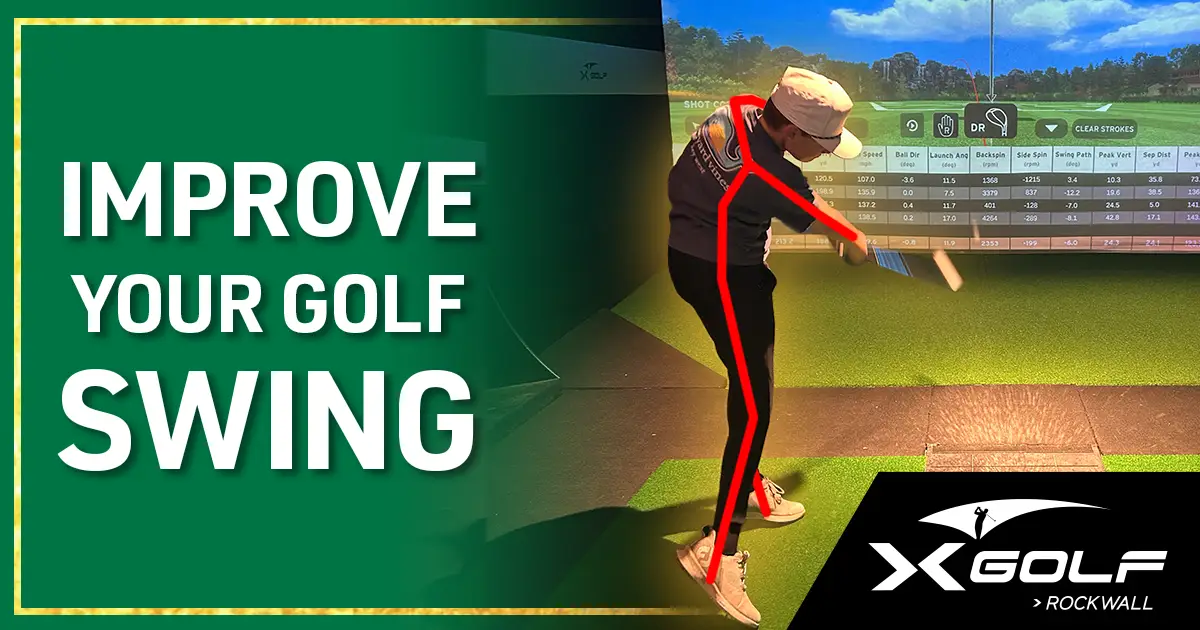
Most beginners practice everything at once and fix nothing. Here’s how to find what’s holding your swing back and drill the right fix.
Why most beginners practice the wrong things
Walk into any driving range in Rockwall on a Saturday morning and you’ll see the same scene. A beginner buys a bucket, pulls out the driver, and starts launching balls for 45 minutes with no idea what they’re working on.
The time you spend doesn’t matter much if you don’t know what you’re trying to fix. A tempo drill won’t fix a swing plane issue. A weight shift drill won’t help if your real problem is a disconnected takeaway. The best golf swing drills for beginners are the ones that match a specific problem, and that means figuring out which problem you actually have first.
You don’t need a teaching pro to figure this out. Film one swing on your phone, watch it back, and see which of the 5 problems below looks most familiar. That’s your starting point. If you want a broader foundation first, these golf tips for beginners are a good warm-up.
Every swing feels different from the last
You hit one solid, top the next one, chunk the third. Nothing feels repeatable and you have no idea what changed between swings.
The culprit is usually your takeaway. The first 12 inches of your backswing set the path for everything that follows. When the takeaway changes from swing to swing, the rest of the motion has no consistent foundation to build on.
The one-piece takeaway drill: place a headcover on the ground just outside your ball. Sweep the club back low and slow, keeping it inside the headcover line. If you yank the club up or jerk it to the inside, stop and reset. Do 10 slow reps before hitting a single ball. The club should track straight back along the target line without lifting sharply or whipping inside.
When this starts to click, the backswing will feel quieter, more automatic. You’ll notice the difference in your tempo before you even look at where the ball went.
The ball keeps slicing or pulling left
A ball that curves hard right on every full swing (or occasionally yanks left with nothing in between) points to a swing plane problem. Your club is traveling on the wrong path through impact. For most beginners, the club is coming “over the top,” cutting across the ball from outside to inside.
The alignment stick gate drill: grab two indoor golf training aids like alignment sticks and push them into the ground about a clubhead-width apart on your target line, just past where the ball sits. Your goal is to swing through the gate without clipping either stick. Start at half speed with a short iron. Once you can clear the gate consistently at half speed, work up to three-quarter swings and then full swings.
You’ll feel the club drop into a more connected path through impact instead of cutting across the ball. On a simulator, your club path number tells the story. It should creep closer to zero (meaning straight) over a set of 10 to 15 swings. That’s how you know the drill is working and not just feeling different.
You’re swinging hard but the ball goes nowhere
This one frustrates beginners more than almost anything. You feel like you’re putting 100% into the swing, but the ball comes off soft. Friends with smoother swings hit it past you without looking like they’re trying.
The problem is tempo. When you rush the transition from backswing to downswing, your arms take over before your lower body can lead. That throws off the sequence, and the stored energy in your wrists releases too early. In golf terms, you’re “casting” the club, spending your power before the clubhead reaches the ball.
The step drill: start with your feet together. As you begin the backswing, step your lead foot toward the target. That step forces a natural pause at the top and gives your lower body time to lead the downswing. Hit 15 to 20 balls this way, then go back to your normal stance and try to keep that same unhurried feeling.
If you want a second tool, try counting “one-two-three” during each swing: backswing, transition, impact. A metronome app set to 72 bpm works well for pacing.
At X-Golf Rockwall, swinging on a simulator means you see your club speed after every shot. When your tempo locks in, you’ll notice something that feels counterintuitive: club speed stays the same or goes up even though the swing feels slower.
You keep hitting it fat or catching it thin
If you’re catching chunks of turf before the ball or blading shots that scream low across the ground, the problem is probably weight transfer. Your weight is staying on your back foot through impact instead of shifting forward, and that moves the bottom of your swing arc behind the ball.
The press-and-hold finish drill: hit a ball and freeze your finish position for a full 3 seconds. Check two things. First, your belt buckle should face the target. Second, 90% or more of your weight should be on your front foot. If you’re falling backward or your back foot is still flat on the ground, the weight never transferred.
This drill pairs well with simulator feedback. Proper weight shift compresses the ball more consistently, which shows up as a tighter launch angle range and less variation in carry distance across a set of shots. When your 7-iron carry goes from a 15-yard spread to a 5-yard spread, you’re compressing the ball more consistently. A simulator gives you that feedback in a way the range never can.
Your swing feels like all arms, no power
The swing feels disconnected. Your arms are doing all the work while your body stands there watching. Power and consistency both suffer, and the whole motion feels like you’re fighting the club instead of swinging it.
Your torso and arms are moving on separate tracks. If they’re connected, your core generates most of the speed and your arms just follow. But when they’re out of sync, your arms have to do all the work on their own, and they’re not strong enough to keep up.
The baseball swing progression: grab a mid-iron and hold it at waist height. Make flat, baseball-style swings and feel how your torso, arms, and the club all rotate together as one unit. Now gradually tilt the swing down toward the ground over 5 swings until you’re in a normal golf posture. That connected feeling from the baseball motion should carry right over.
A baseball swing naturally links arm movement to core rotation, which is exactly what a golf swing needs. Your body already knows how to do this from throwing a ball or swinging a bat, so the motion usually clicks faster than you’d expect.
Put the drills to work at X-Golf Rockwall
These drills work on their own, but the results come faster when you can see the data after each swing. X-Golf Rockwall’s simulators track club speed, club path, face angle, launch angle, and carry distance on every shot, so you get real confirmation instead of guessing.
If you’d rather have someone watch your swing and point you to the right drill from the start, golf lessons at X-Golf Rockwall pair you with a PGA-certified instructor who can shortcut the trial and error.
Pick the drill that fits your problem and put in the reps. Then book a tee time at X-Golf Rockwall to see how it holds up with real data behind every shot. Or if you want to test it under pressure, the Thursday Night League is a good place to find out what your swing does when there’s a leaderboard involved.