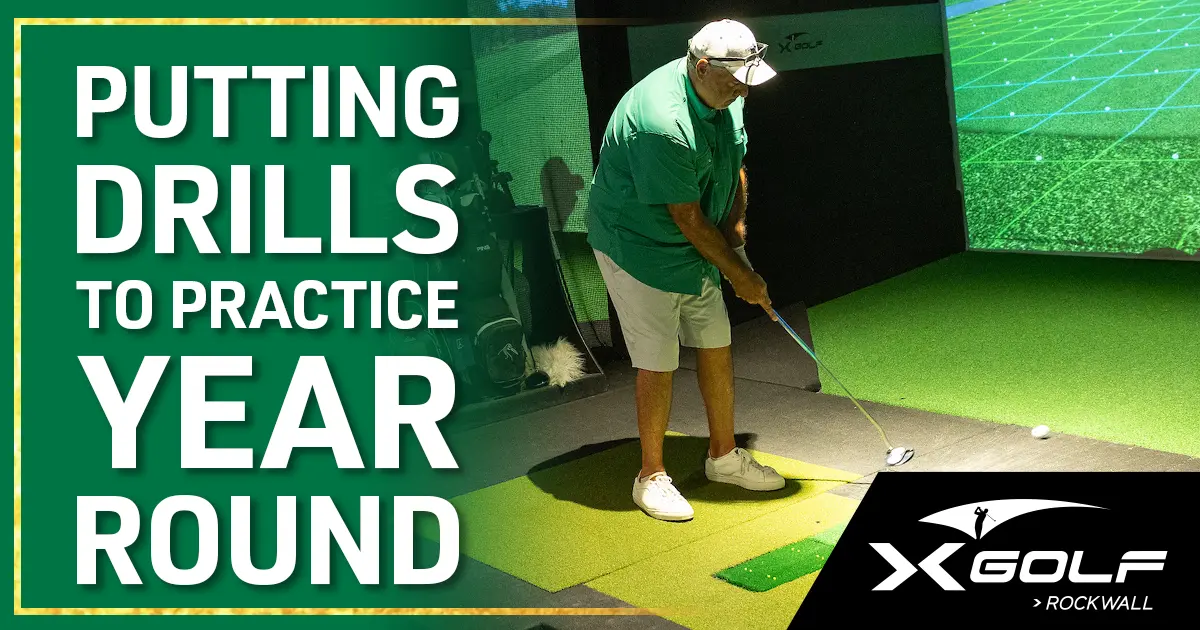
These 8 golf putting drills target four common problems: a shaky start line, off-center contact, nerves during short putts, and bad speed. Depending on the drill, you can do it at home, on a practice green, or in a bay at X-Golf Rockwall.
How to Pick the Right Putting Drill
Pick the drill that targets the miss you see most. For putts that leak left or right of your line, you should practice the gate drill. If you miss inside 4 feet, run the clock drill and the make-10 drill. Three-putts from long range point to speed, so spend that time on the ladder and lag drills. The following table covers details on each drill:
| Drill | What it fixes | Where you can run it | About how long |
|---|---|---|---|
| 1. Gate drill | Start line | Home, green | 10 minutes |
| 2. Coin drill | Center contact | Home, green | 5 minutes |
| 3. Lead-hand-only drill | A wristy stroke | Home, green, bay | 5 minutes |
| 4. Clock drill | Short putts | Green | 10 minutes |
| 5. Ladder drill | Speed | Green, bay | 10 minutes |
| 6. Lag-to-a-circle drill | Long putts | Green, bay | 15 minutes |
| 7. Past-the-hole drill | Leaving putts short | Green | 10 minutes |
| 8. Make-10-in-a-row drill | Pressure | Green | 10 to 15 minutes |
Golf putting drills at home focus mostly on the start line, contact and a quiet wrist: elements for a good stroke. A carpet or mat stays flat at one speed, so it can’t teach you to judge pace or break. For better practicing results, pair your home sessions with time on a real green or a simulator. When you’re ready to practice reading slope, our green reading drills pick up where this list stops.
1. Gate Drill: Start Every Putt on Your Line
Push two tees into the green about 6 inches in front of the ball, with about a putter head’s width of room between them. On carpet, two coins do the same job. Pick a straight 4- to 6-foot putt and roll 10 balls through the gate. You’ll see on every putt whether the ball starts where you aimed.
A ball that clips a tee started off line, so check where the putter face pointed at impact before you blame your aim. Once you get all 10 through, move the tees closer together until the gate is just wider than the ball.
Setup takes about a minute, making this the easiest drill on the list to practice on a weeknight in front of the TV. It’s also the perfect drill to revisit whenever you notice your putts consistently missing on the same side of the hole.
2. Coin Drill: Find the Center of the Putter Face
A coin laid flat on the ground helps teach you to find the center of the putter face. Set a quarter on the carpet at home or on a practice green, address it like a ball, and take your normal putting stroke. A clean hit sends the coin straight forward, while contact on the toe or heel causes it to veer off to one side.
Take 10 strokes at the coin, then putt real balls. Center contact is essential for speed, because a putt struck away from the sweet spot comes off the face weaker than one struck flush with the same stroke. By fixing contact, your distance gets more predictable.
3. Lead-Hand-Only Drill: Quiet a Wristy Stroke
Putt using only your lead hand (the left hand for right-handed golfers) to expose any wrist flipping through impact. Move your grip down slightly and hit 10 putts from 3 to 6 feet with that hand alone, then hit 10 more with both hands.
A good one-handed stroke feels like your lead arm and the putter move as one piece, with the back of your wrist staying flat. If the putter head races past your hands, the wrist is doing the work. You can practice this anywhere, including the putting platform in a bay at X-Golf Rockwall.
4. Clock Drill: Own the 3-Footer
The clock drill builds the confidence that keeps short putts from turning pars into bogeys. Place four tees around the hole at the 12, 3, 6, and 9 o’clock positions, each 3 feet from the cup. By picking a hole on a slight slope, every putt will break a little differently.
Work around the clock. Miss one, and you start again at the 12 position. PGA coach Brendon Elliott, writing for PGA.com, recommends a 3-foot circle version of this drill.
Once you can go around twice without a miss, add a second ring at 4 feet, then 5 feet. Run it on a practice green, where the cup and the slope are real.
5. Ladder Drill: Dial In Your Speed
The ladder drill improves distance control by challenging you to roll each putt slightly farther than the previous one. Training this skill determines whether your first putt leaves a tap-in or a nervy 6-footer.
On a green, start at one edge and putt five balls toward the far side. Your first putt should stop about 3 feet from you. Each following putt must finish past the previous ball but short of the far fringe. If a ball comes up short of the one before it, or rolls off the green, start over.
In a bay at X-Golf Rockwall, the putting platform gives you reference points instead of a fringe. X-Golf’s own guide for the platform says a 16-foot putt should just reach the screen, and an 8-foot putt stops about halfway up the platform. For a 30-foot putt, the guide is about twice the length of the platform. Use those three distances as your rungs, and repeat each one until the ball finishes near the hole on screen. Our guide to how putting works on the simulator covers the platform in more detail.
6. Lag-to-a-Circle Drill: Two-Putt From Anywhere
From 25 to 40 feet, your goal is to finish every ball inside a 3-foot circle around the cup, so the next putt is a tap-in.
On a practice green, mark the circle with a few tees. Pick three spots between 25 and 40 feet away, hit 10 balls from each, and count how many finish inside. Write the number down each session, so you can see your speed control improve.
In the bay, pick a long putt on a course green and play it out. Use the putting preview to get a camera angle of the putt before you hit it, then judge your performance by how close the first putt finishes to the hole.
7. Past-the-Hole Drill: Stop Leaving Putts Short
Every putt in this drill has to finish past the hole, and any ball that comes up short means you start over. It retrains a timid stroke that leaves the ball short of the cup.
Start at 6 feet, then move to 10 feet and 15 feet, hitting five balls from each spot. If a putt misses, it should stop 12 to 18 inches past the hole. A ball left short sends you back to 6 feet. Run it on a practice green, where you can reset the same three distances as often as you need.
8. Make-10-in-a-Row Drill: Practice Under Pressure
Set up on a straight 5-footer and make 10 in a row, starting over after any miss. The first few feel easy. Somewhere around number 8 or 9, your hands start to tighten. That’s the feeling you want to practice under.
If 10 straight takes forever, change to 4 feet for a week. This drill is a good rehearsal for a 5-footer on league night, with your buddies watching from the next chair (and talking).
Build a Year-Round Putting Routine at X-Golf Rockwall
Run the home drills during the week, then book a bay at X-Golf Rockwall for the speed drills when a storm or an August heat wave keeps you off the practice green. A simple week looks like this:
- Two 20-minute sessions at home: the gate, coin, and lead-hand drills
- One hour in a bay for the ladder and lag drills, or on a practice green for those plus the clock, past-the-hole, and make-10 drills
Each bay has a raised putting platform with spots for right- and left-handed golfers. On-screen, moving dots show the break of the green. The kitchen brings food and drinks to the bay, so a practice hour can turn into dinner. We provide the balls, and you’re welcome to bring your own putter.
If you want a coach’s eye on your stroke, book golf lessons at X-Golf Rockwall. For more off-season ideas, read how to practice golf in the winter, or learn to practice like a tour pro on the simulator.