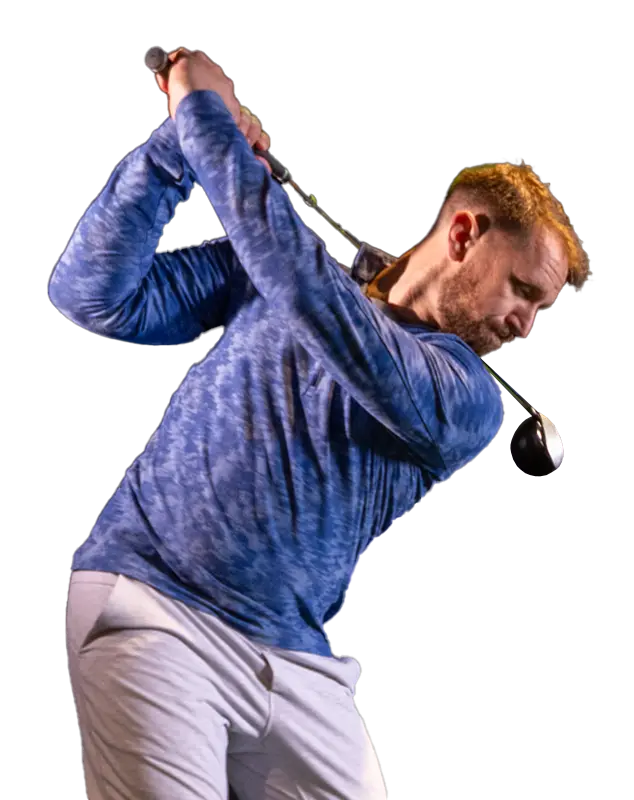
You finally stopped slicing. Your ball is drawing nicely off the tee, curving left with purpose. Then one afternoon it keeps curving, past the fairway, past the rough, into places you’d rather not think about. That controlled draw has turned into a full-blown hook, and it’s costing you strokes.
Most golfers don’t realize this, but a hook actually means you’re generating clubhead speed and closing the face at impact. You’re closer to consistent ball-striking than you think. The fix comes down to a few small adjustments you can practice indoors, where you get actual data on what’s changing.
What causes a hook?
A hook happens when the clubface is closed relative to your swing path at impact. For a right-handed golfer, the ball starts right of target and curves hard left, usually with a low, diving trajectory that runs forever in the wrong direction.
The usual suspects:
- a grip that’s too strong, where your hands are rotated too far to the right on the club and the face wants to close through impact (look down at your left hand — if you see four knuckles, that’s your problem)
- incomplete body rotation, where your hips and torso stop turning through the shot and your hands take over, snapping the face shut
- a swing path that’s too far inside-out, which combined with a closing face creates that sharp left-to-left ball flight nobody wants
Most golfers have one primary cause. Some have two working together. Figuring out which one is yours matters, because the drills below target different parts of the problem.
Check your grip first
Before you change anything else, look at your hands. Grip is the most common reason people hook, and it’s the quickest thing to adjust.
Hold the club at address and glance down at your lead hand (left hand for right-handed golfers). You should see two to three knuckles. Four knuckles means your grip is too strong, and the face is closing before you even swing.
Rotate both hands slightly to the left on the grip. The V shapes formed by your thumbs and forefingers should point somewhere between your chin and right shoulder. This is subtle — a quarter-inch rotation can make a real difference.
Spend a few minutes each day just holding the club with this adjusted grip. It has to feel normal before you take it into full swings, and that takes reps.
Drill 1: Punch shots
If you only do one drill from this article, make it this one. Punch shots keep your hands quiet through impact and prevent the wrist rollover that closes the face.
Grab a 7-iron or 8-iron. Set up for a half-swing. You’re aiming for a low, controlled ball flight at about 70% of your normal distance, with a short follow-through. Hands finish around chest height, not wrapped around your body.
The whole point is training a stable clubface through the hitting zone. When you cut the follow-through short, your wrists physically can’t flip and shut the face. Twenty to 30 reps per session, and you’ll start feeling a firmer release.
What makes this drill especially useful at X-Golf Rockwall is the face angle readout. You can watch the number on every single rep. If you started at minus four degrees and you’re now at minus one, you know it’s working. No guessing involved.
Drill 2: Lead hand only swings
This one targets rotation. Golfers who hook tend to let their trail hand dominate the downswing, which closes the face. Take the trail hand off the club and you force your body to do the turning.
Set up with a short iron, remove your right hand (for right-handed golfers), and make smooth swings with just your left. Focus on keeping your left shoulder turning open through the ball and finishing with your chest facing the target.
Start small — quarter swings, half swings. You’ll top some. You’ll hit some thin. That’s normal. The drill isn’t about making solid contact. It’s about feeling your body rotate instead of your hands flip. This one works well indoors because you don’t need power or distance. Just reps.
Drill 3: Alignment stick gate
This drill is for golfers whose path is the issue. Lay two alignment sticks on the ground parallel to your target line, about six inches apart. Position them just ahead of the ball, right in the impact zone. You’re creating a narrow corridor for your clubhead to travel through.
Hit shots. If your path is too far inside-out, you’ll clip the inside stick. The goal is to swing through the corridor cleanly, which nudges your path straighter.
At home, you can use painter’s tape on the floor for the same effect. At X-Golf Rockwall, you get the sticks plus a swing path readout showing exactly how many degrees inside-out or outside-in you’re swinging. That way you’re not just feeling the change — you’re confirming it with numbers.
Drill 4: Pause at the top
Bad tempo makes hooks worse. When you rush the transition from backswing to downswing, your lower body can’t lead. Your arms fire early, the face closes, and the ball dives left.
Take your normal backswing, then stop. Full second pause at the top. Feel your weight over your right foot. Then start the downswing by shifting toward the target and letting your hips go before your arms drop.
That pause breaks the rushing habit. Do 15 to 20 reps with the pause, then take it away and swing normally. The motion should feel slower and more connected.
Why a simulator helps you fix this faster
Working on swing changes at a driving range has a built-in problem. You’re watching ball flight and guessing what went wrong. Was it the grip? The path? The rotation? On a range, you’re basically doing detective work without evidence.
At X-Golf Rockwall, every shot gives you numbers: face angle, swing path, ball speed, spin rate, launch angle. You don’t have to guess which drill is working. You can see it.
X-Golf’s proprietary technology uses laser, light, impact, and camera sensory systems to measure every shot at 98% accuracy. When the numbers say your face is square, it is.
A 30-minute practice routine
Start every session with about five minutes on your grip. Confirm your hand position before you hit anything, because if the grip drifts back to where it was, nothing else you do will stick.
From there, move into 15 to 20 punch shots. Watch your face angle data on each one and aim for numbers closer to zero. Once those feel solid, switch to 10 lead hand only swings to reinforce the rotation pattern.
Next, set up the alignment stick gate and hit 15 to 20 shots through the corridor. Check your path numbers after each set to make sure you’re trending straighter. Finish the session with full swings, applying the feels from your drill work and watching how the ball flight responds.
Run through this two to three times per week and you should see real improvement within a few weeks.
Stop hooking, start scoring
A hook is fixable. Your swing already has speed and your clubface is active. You just need those two things working together instead of against each other.
Book a tee time at X-Golf Rockwall and bring your alignment sticks. If you’d rather have an instructor watch your swing and tell you what’s actually happening, check out our indoor golf lessons. They’ll use the simulator data to pinpoint the cause and give you a plan that’s specific to your miss.
Call (469) 314-1808 to check lesson availability or reserve a bay.