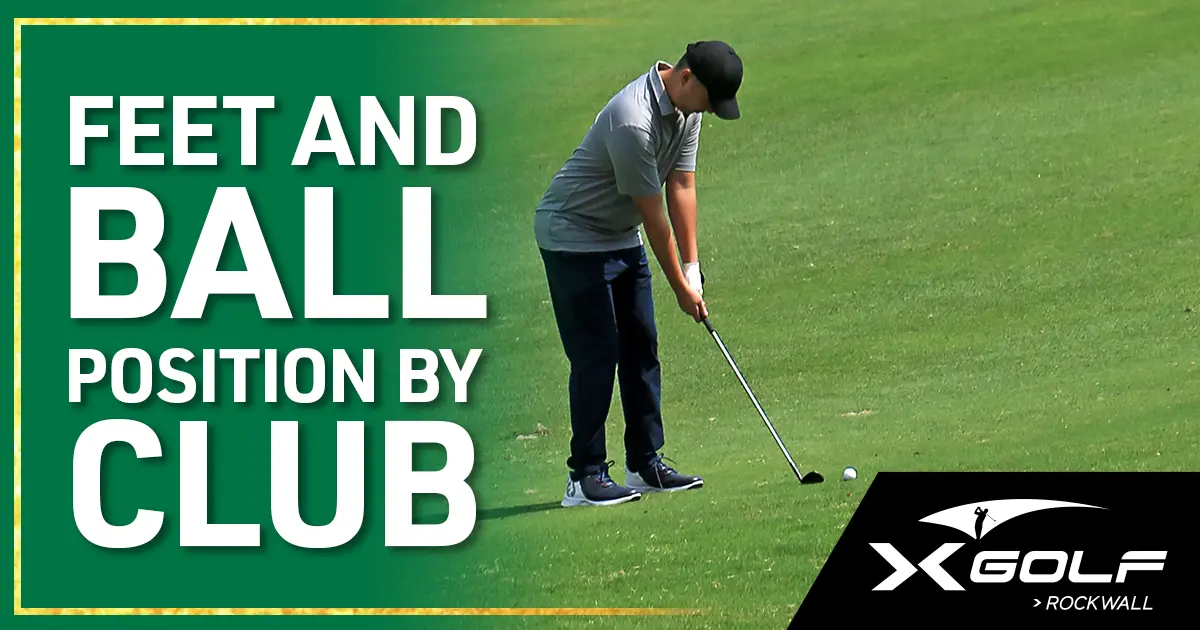
Your driver setup and your wedge setup are two different setups. Here is where your feet and the ball go for every club in the bag, plus one chart you can come back to.
What a golf stance is and what it controls
A golf stance is how you set your feet, your weight, and the ball before you swing. It controls where the club reaches the bottom of its arc, which decides whether you catch the ball first, the turf first, or nothing but air.
Three things make up that setup: how far apart your feet are, where the ball sits between them, and how your weight splits between them. None of it is a matter of preference. Each club in your bag is a different length, sits at a different angle, and is built to strike the ball a different way, so moving your feet moves the bottom of your swing with them.
A driver wants to catch the ball on the way up. A pitching wedge wants to catch it on the way down. You can make the same swing at both and still get two results that look nothing alike, because the setup underneath them is doing different work.
Why one stance for all 14 clubs falls apart
Most casual players build one setup, usually the one that felt good the first time they made contact, then use it for all 14 clubs. It is the most common thing we see in the bays at X-Golf Rockwall, and it is almost never a swing problem.
It shows up in one of two ways. You put the ball off your lead heel, where a driver belongs, then pull a 7-iron: the club bottoms out several inches behind the ball, you catch ground first, and you assume you swung badly.
Then you go the other way. You keep the ball centered, fine for a 9-iron, and hit driver from there, so the club is still moving down at impact and you get a low, spinny drive that lands 40 yards short.
Two opposite misses, one cause: the club in your hands changed and your feet never did.
It also explains a fat wedge better than any swing tip will. If your irons dig before they reach the ball, start at your feet and read why irons come out fat and how to stop chunking them.
This page covers how you set up once a club is in your hands. Which club to pull is a different question, handled in how to choose the right club for the shot in front of you.
Golf stance and ball position, club by club
The chart below covers the whole bag. Every ball position is described against a landmark you can find while standing over the shot, and “lead” means your left side if you play right-handed, your right side if you play left-handed.
| Club | Stance width | Ball position | What the setup is for |
|---|---|---|---|
| Driver | Widest in the bag, an inch or two outside your shoulders | Off the inside of your lead heel | Catching the ball on the way up for high launch and low spin |
| Fairway woods and hybrids | Just outside shoulder width | About 1 to 2 inches inside your lead heel | Sweeping the ball off the turf with a shallow strike |
| Long irons (3, 4, 5) | Shoulder width | About 2 inches inside your lead heel | A gentle downward strike with room to square the face |
| Mid irons (6, 7) | Shoulder width | One ball forward of center, roughly under the logo on your shirt | Ball first, then turf, with a divot that starts after the ball |
| Short irons (8, 9, pitching wedge) | A touch inside shoulder width | Center of your stance | A steeper downward strike for spin and control |
| Wedges | Narrowest in the bag | Center to one ball back of center | A steep, ball-first strike that grabs the green |
| Putter | Narrow, around hip width | Slightly forward of center, under your lead eye | Rolling the ball rather than driving it into the green |
Driver
This is the widest stance you will take all day. Your feet sit an inch or two outside your shoulders, and the ball goes off the inside of your lead heel.
That combination leaves your upper body slightly behind the ball, which is the point. The club has already passed the bottom of its arc by the time it arrives, so it strikes upward, and upward means higher launch with less spin. That is what turns a 220-yard drive into a 250-yarder without swinging harder.
Tee height matters here too. X-Golf Rockwall’s bays use an auto-tee that saves your height to your player profile, so once it matches this setup it comes back the same every visit.
Fairway woods and hybrids
Bring your feet in a little from your driver stance, to about an inch outside your shoulders, and move the ball one to two inches inside your lead heel.
These clubs are long like a driver but sit on the turf instead of a tee, so you want a flatter, sweeping strike. Moving the ball back that inch or two brings the bottom of your arc close enough to brush the grass without digging.
If you have never worked out whether you sweep or dig, read the different golf swing types and what each one demands alongside this.
Long and mid irons
Both groups want shoulder width, heels under your armpits.
Long irons (3, 4, 5) sit about two inches inside your lead heel. They are long and have very little loft, meaning the face stands close to vertical, so they need a fraction more room to square up.
Mid irons (6 and 7) come back to roughly one ball forward of center, and the old cue still works: look down and the ball should sit under the logo on your shirt. From there the club is still descending at impact, so you catch ball first and turf second, with the divot starting after the ball.
Short irons
Pull your feet just inside shoulder width and put the ball dead center.
These are the shortest full-swing clubs you own, and they earn their money on control, not distance. A narrower stance and a centered ball give you a steeper swing, which puts more backspin on the ball and stops it nearer to where it lands.
Most people already own this setup, and the trick is keeping it off the other 11 clubs.
Wedges
Your wedges want the narrowest stance in the bag, with the ball anywhere from center to about one ball behind center on a full swing.
Pulling the ball back that fraction steepens the strike. The leading edge has to reach the ball before the turf, and that is what produces the bite that holds a green. On shorter pitch shots, keep your feet close together and leave the ball near center.
Dead center works for a full wedge too, and either spot gives you a clean strike. The one to avoid is a wedge played off your lead heel, which produces fat shots and thin shots in roughly equal numbers.
Putter
A putter needs almost nothing from your feet. Stand about hip width apart, with the ball slightly ahead of center and sitting under your lead eye.
The logic matches the driver, just at 3 feet per second instead of 100 miles an hour. Catch the ball at the bottom of the stroke or a fraction after and it rolls right away instead of bouncing and skidding for the first foot.
Push the ball too far forward and your shoulders open up, aiming you left of the hole without you noticing. Too far back and they close, and you aim right.
How far to stand from the ball
The club’s length sets that distance, so you never measure it. Use the same posture for every club, let your arms hang straight down, and the shaft decides where your feet end up.
Alex Elliott, a Golf Monthly Top 50 Coach, gives the method: hold the club out in front of you with the shaft parallel to the ground, tilt forward from the hips, then shuffle in until the club head sits behind the ball.
Your hands stay the same distance from your body for every club. Only the shaft changes, which is why a driver leaves you farther from the ball than a wedge does.
Where your weight goes for each club
Start every full shot at 50/50, half your weight on each foot, and move it only for a reason. Weight travels much less between clubs than your feet or the ball do.
| Club | Weight at address | Why |
|---|---|---|
| Driver | Even, with your upper body tilted slightly away from the target | Keeps you behind the ball so the club strikes upward |
| Fairway woods, hybrids and long irons | Even | A sweeping strike needs the bottom of your swing at the ball, not behind it |
| Mid and short irons | Even | Ball position, not weight, creates the downward strike |
| Wedges and pitch shots | A little more on your lead foot | Steepens the strike so the leading edge reaches the ball first |
| Putter | Even, and still | Any shift during the stroke moves the bottom of the arc |
Feel it under your arches rather than back in your heels. Sitting into your heels moves the bottom of your swing behind the ball before you start.
How to tell where the ball really is in your stance
Your own eyes are the least reliable part of the setup. Plenty of golfers certain the ball is centered are looking down at one sitting two inches forward, because you view it from behind and above rather than straight over it.
Check it against something outside your own head. Three ways, quickest first:
- Lay a spare club on the ground pointing at your target, set up as normal, then check where the ball sits relative to your lead heel
- Film yourself face-on with your phone at hip height and freeze the frame at address. It takes 20 seconds and settles the argument
- Read the strike itself. With any iron the mark should start at the ball, and one that starts behind it means the bottom of your swing is behind it too.
The third one is where a bay does something a bucket of range balls cannot. X-Golf Rockwall’s bays read the shot with four lasers and a high-speed camera, and one number that comes back is smash factor, which compares how fast the ball leaves the face with how fast the club head was moving into it. A bigger number means you caught it cleaner.
So when you catch one off the toe or low on the face, the number tells you before your hands do. The comparison is the useful part: across a handful of shots, the setup returning the higher number is the one putting more of your speed into the ball.
The hitting mat has white dots marking the zone where the sensors get the cleanest read, so the ball stays put and you move your feet around it. That feels backwards at first, but it is the quickest way to learn a driver stance and a wedge stance as two separate things.
A drill worth an hour: hit five 7-irons one ball forward of center, five dead center, and five off your lead heel, then compare the carry numbers and the smash factor for each group. Your best strike does not always come from the position the chart predicts.
Lie and slope change what the chart says
Every position in the chart assumes a flat lie, and a golf course hands you very few of those.
On a downhill lie the ground falls away from you, so the bottom of your swing arrives earlier. Play the ball back a little and lean with the slope. Uphill, the ball moves forward instead.
When the ball sits above your feet you stand taller and choke down on the grip. When it sits below your feet you widen your stance for balance.
Rough and sand move things again. Thick grass wants a steeper strike, so the ball comes back toward center. In a greenside bunker it goes forward and your feet dig in.
Reps are what make those adjustments automatic. In practice mode you can drop a ball at any distance and on any lie on any hole, so you can stand on the same downhill slope 15 times in a row until it stops feeling like a guess.
A punch shot is the one deliberate exception. Move the ball an inch back of where the chart puts it, pull your feet in slightly, and set a little more weight on your lead foot. That delofts the club and keeps the flight under the wind or a low branch.
Run your whole bag through one bay in Rockwall
An hour in a bay at X-Golf Rockwall gets you through every club on this page, in order, with a strike reading after each one. A driving range in the August heat will not give you that, and neither will an afternoon with the wind pushing in off Lake Ray Hubbard. Here the kitchen and bar come to you while you work.
Come alone or bring five friends and turn it into an argument about whose setup is worse. Either way you leave knowing which clubs you have been setting up wrong, and Toni and the team can point you at a lesson.
New to the bays? Start with how a swing works at an X-Golf simulator, then book a bay at X-Golf Rockwall.