Every topped shot leaves a trail in your simulator data. Here’s how to read it and fix the swing fault behind it.
What happens when you top the golf ball
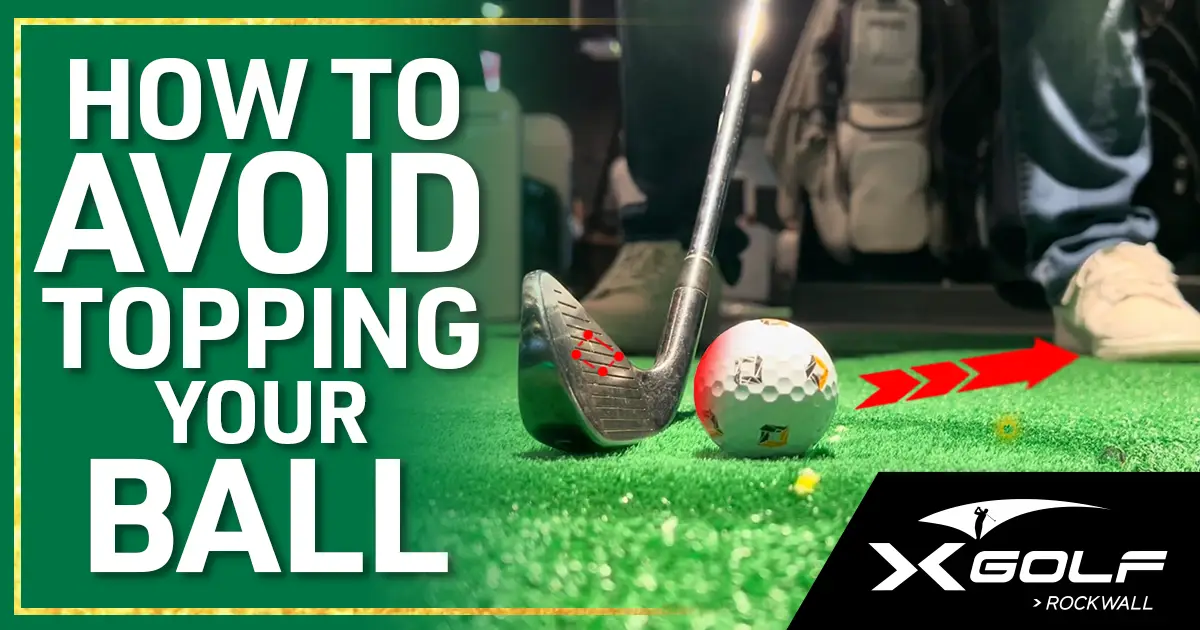
Topping the golf ball means the club’s leading edge catches the upper half of the ball instead of compressing it cleanly. The result is a low, weak roller that barely gets off the ground.
On a simulator screen, topped shots show a clear pattern. Your launch angle drops to near zero (or goes negative), the impact position sits at or above the center of the clubface, and your smash factor tanks below what that club should produce. Those three numbers confirm you topped it before you even look up from the mat.
Topped shots eat distance and wreck your confidence for the next swing. Fixing this one problem often improves your entire ball striking because the same mechanics that cause topping affect the rest of your game, too.
The 4 causes behind every topped shot
If you want to stop topping the golf ball, it almost always comes back to one of four swing faults. Each one raises the club’s lowest point so it catches the ball on the way up instead of on the way down:
- standing up through impact (early extension), which lifts your entire swing arc above the ball
- ball position too far forward in your stance, so the club reaches the ball after it’s already ascending
- weight staying on your trail foot through impact instead of transferring to your lead side
- lifting your head or eyes before contact, pulling your upper body upward with it
How to stop topping your driver
Start with your ball position. Set it off the inside of your front heel with half the ball sitting above the crown of the driver. This promotes contact on the upswing, which is exactly where you want to catch it with a driver.
The biggest mistake with drivers is trying to help the ball into the air. Trust the 10.5 degrees of loft on the clubface and let your hips rotate toward the target while your head stays behind the ball through impact.
Your simulator data confirms when you’ve got it right. Look for a launch angle between 10 and 15 degrees and an impact position that’s center or just above center on the face.
How to stop topping irons and fairway woods
With irons, ball position shifts toward the center as the clubs get shorter. Fairway woods sit a couple of inches forward of center. Your goal with both is to hit the ball first, then the ground, with your divot starting just ahead of where the ball sat.
If your weight stays on your trail foot through impact, the club bottoms out too early and catches the top half of the ball. Practice the step-through drill: after impact, let your trail foot step forward toward the target to force your weight onto your lead side. This is the opposite problem from chunking your irons, but the root cause is the same, your low point is in the wrong spot.
On the simulator, check these numbers after each iron or fairway wood shot:
- angle of attack should be slightly negative (descending) for irons, close to zero for fairway woods
- impact position should sit center or slightly below center on the clubface
- launch angle should roughly match the club’s expected loft (around 16 to 18 degrees for a 7-iron, for example)
A quick drill you can try right now
Place a towel 3 to 4 inches behind the ball. If you catch the towel on your downswing, your swing is bottoming out too early, and that’s what causes the top.
Build the drill up gradually:
- Half swings with a pitching wedge until you consistently clear the towel
- Full swings with the same wedge once you’re making clean contact
- Full swings with a 7-iron to confirm the fix carries across your bag
At X-Golf Rockwall, you can run this drill with instant data on every shot. You’ll see your launch angle and carry distance improve in real time, which takes the guesswork out of practice.
Book a bay and see the difference
If you want to stop topping the golf ball faster, pair these fixes with real-time feedback. A simulator shows you whether your adjustments are working, shot by shot, so you know exactly when something clicks.
Book a tee time at X-Golf Rockwall and put these fixes to the test. Grab a bay, work through the towel drill, and watch your numbers change on screen. If you want hands-on coaching, our golf lessons pair you with an instructor who can read your data alongside you and spot what you might miss on your own.
Frequently Asked Questions
Can I fix topping without taking a lesson?
Yes. Most topped shots come from setup issues like ball position and weight distribution that you can correct on your own with a few focused range sessions. A simulator speeds this up because it gives you numbers to track instead of relying on feel alone. If you’ve worked through these fixes and still top it regularly, one lesson with a pro can catch swing habits you can’t see yourself.
How long does it take to stop topping the ball?
Most golfers see fewer topped shots within 2 to 3 focused practice sessions once they identify the root cause. The towel drill alone shows results fast because it retrains your low point directly. Give it a few weeks of regular practice to lock in the change, and don’t be surprised if the occasional top still sneaks in during a round while the fix becomes second nature.
Why do I only top my driver but not my irons?
Drivers and irons require different angles of attack. With irons, you hit down on the ball. With the driver, you hit slightly up. If your swing defaults to a descending strike, your irons may feel solid while your driver catches the top of the ball because it needs that upward path. Teeing the ball higher (half above the clubface) and moving it forward to your front heel usually fixes this.